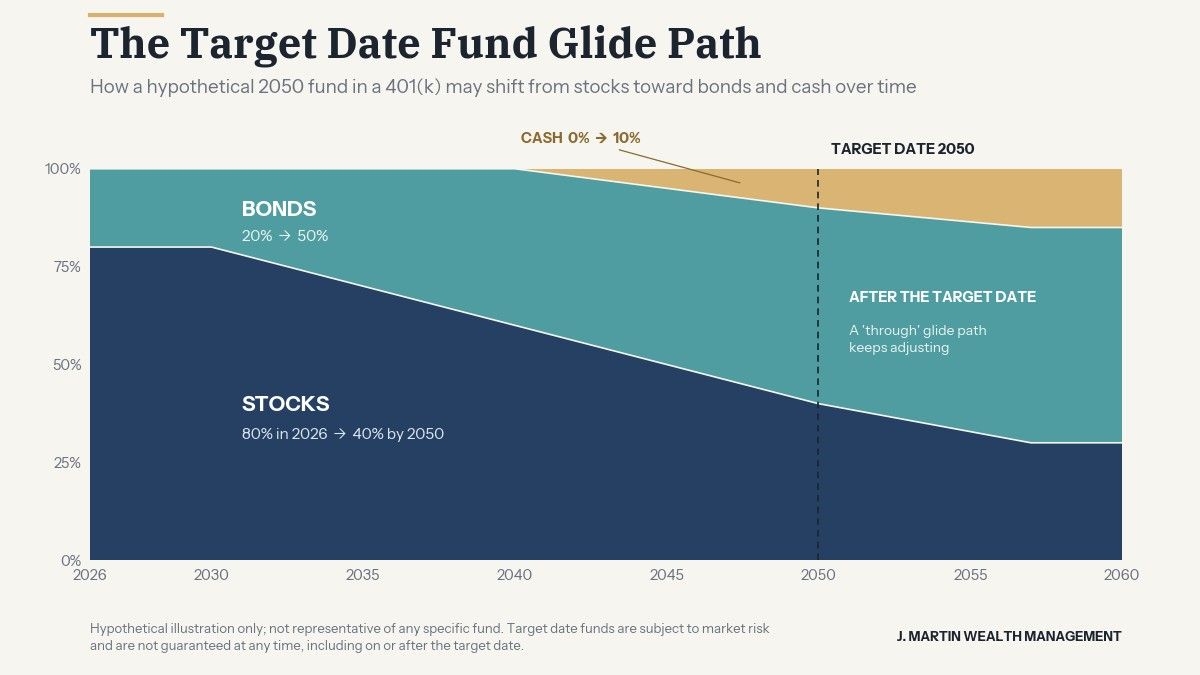
Target Date Funds (TDFs) are rooted in a glide path, a formula that dictates changes in asset allocation over time. Initially, the fund leans towards riskier assets, such as stocks, to capitalize on their potentially higher long-term gains. As the target date approaches, the fund steadily shifts towards more conservative, less risky assets to help protect the accumulated wealth.
TDFs are commonly used in employer-sponsored retirement savings plans, such as 401(k)s, because they suit a wide range of employees across various ages and life stages.
How Target Date Funds Work
For example, a Target Date Fund set for 2050 might start with an 80%-20% stocks-to-bonds ratio in 2026. Over the years, this ratio could shift toward a 40%-50%-10% stocks-fixed income mix by 2050, thereby potentially lowering risk as the investor nears retirement.
There are several pros and cons to TDFs:
Pros of Target Date Funds
· Simplicity and convenience – TDFs handle asset allocation and rebalancing, making them a convenient investment option for those with limited financial knowledge or time. Investors need to pick a fund with their anticipated retirement date, and the fund manager handles the rest.
· Automatic rebalancing – The fund's asset mix adjusts automatically, eliminating the need for investors to re-evaluate and rebalance their portfolios manually.
· Diversification – TDFs offer exposure to various asset classes, working toward an inherently diversified portfolio that can reduce risk and provide steadier returns.
Cons of Target Date Funds
· One-size-fits-all approach – TDFs assume that all investors with the same target date share the same risk tolerance. However, individual financial situations, retirement goals, and risk appetites vary, which may make TDFs less suitable for some investors.
· Lack of flexibility – Once invested in a TDF, an investor has little to no control over the fund's asset allocation. This can be disadvantageous in certain market conditions where an investor may prefer to take a more active role in managing their investments.
· Potential for higher fees – TDFs may have higher expense ratios because they are essentially fund-of-funds, meaning the investor pays management fees for the TDF itself and the underlying funds it invests in.
· False sense of safety – The automatic adjustment of the asset mix may lead some investors to believe their investment is "less risky". However, all investments carry inherent risks, and TDF performance can fluctuate.
In conclusion, while Target Date Funds offer convenience and diversification, investors must understand their limitations. TDFs may not fit everyone's unique financial circumstances, and their fees can be higher. Investors should carefully evaluate their needs, risk tolerance, and retirement goals with a financial professional before selecting an investment strategy within their employer-sponsored retirement plan.