IRA to Roth Conversion

What to Know About Roth IRA Conversions

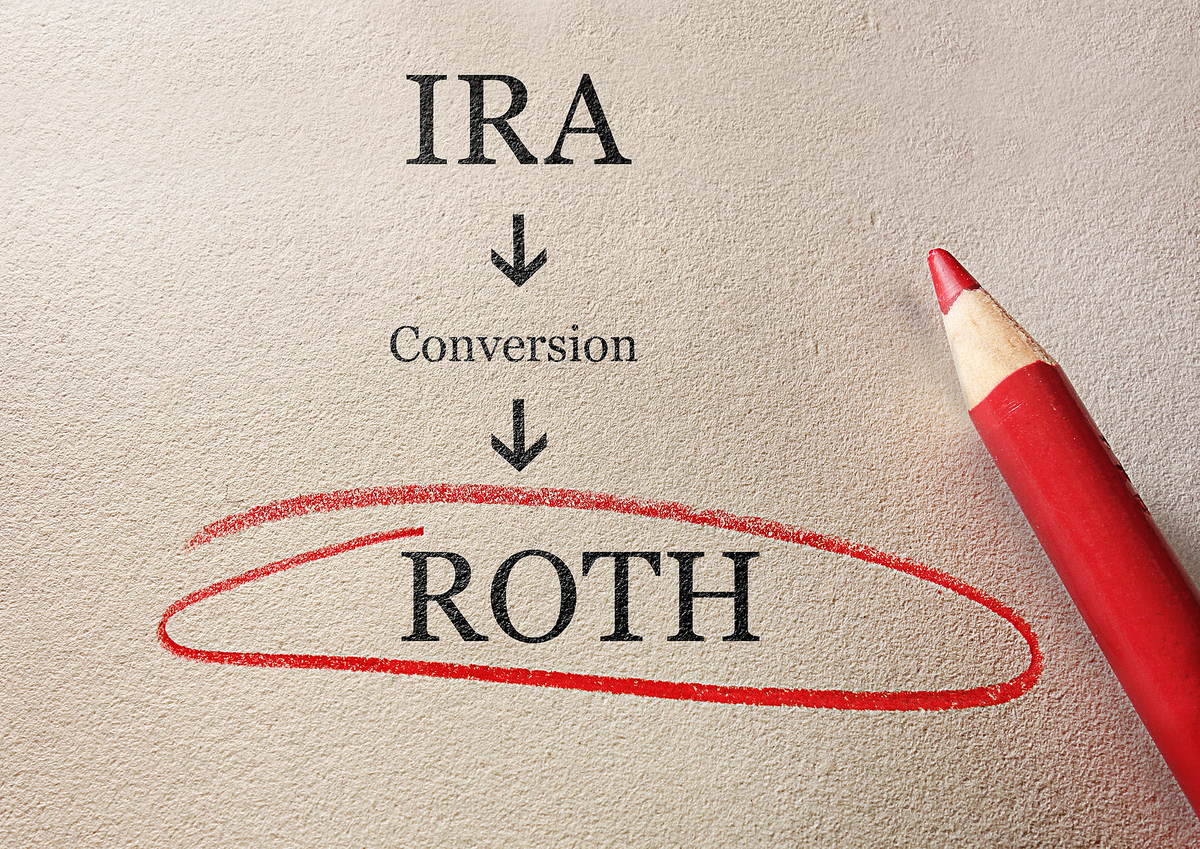
Wouldn't it be nice to pay fewer income taxes in retirement? A tax-advantaged strategy called a Roth IRA conversion may lower your taxable income later in retirement. A Roth IRA conversion involves repositioning a traditional IRA or qualified employer-sponsored retirement plan assets into a Roth IRA. There are a few reasons why investors may pursue a Roth IRA conversion strategy:

· A Roth provides the flexibility to withdraw money when needed.

· There is no Required Minimum Distribution (RMD).

· A Roth IRA conversion as part of estate planning may help lessen the impact of estate taxes on an estate.

Before initiating a Roth IRA conversation strategy, here are things to consider before making your decision:

#1- You will have to pay taxes. Since traditional IRAs and other qualified retirement plans are tax-deferred, upon converting assets into a Roth IRA, the account owner must pay income tax on the amount they convert. Also, the taxes are due upfront when the conversion occurs.

#2- Your Adjusted Gross Income (AGI) may increase. A Roth IRA conversion will increase your income in the year that the conversion happens. Increasing your AGI may also impact your income tax as you move into another income tax bracket.

If you are retired, be mindful that Medicare Part B uses your two previous years' income to calculate your monthly premium, and the conversion may increase your Part B payment for at least two years.

#3- You may lose eligibility for specific tax write-offs. The child tax credit and student loan interest deduction are based on personal income, and initiating a Roth IRA conversion may mean you lose these deductions if your AGI increases.

#4- You may pay a penalty if you need the money within five years. Roth IRAs typically offer penalty and tax-free withdrawals anytime on contributions. Still, investors must wait five years to withdraw the funds without a 10% penalty when using conversion monies, regardless of age. If you anticipate needing money from your Roth IRA before the five-year rule sunsets, there may be a more appropriate strategy for you.

#5- Your qualified retirement plan may not allow Roth IRA conversions. If you have your retirement savings inside your employer's retirement savings plan, check the plan's documents to see if a Roth IRA conversion is allowed. If not allowed and you initiate the conversion, the conversion may not occur, or a penalty will be applied when the conversion happens. Consult your employee handbook, human resources professional, or employer-sponsored retirement plan's custodian for answers about your situation.

You need to meet with your financial and tax professionals to determine how a Roth IRA conversion may impact your taxes at tax time. While a Roth IRA conversion may interest you, be sure you understand the pros and cons of initiating this strategy.

A financial advisor with a fiduciary duty provides this commentary and serves individuals and families across Arizona.

Past performance is not indicative of future results. The material above has been provided for informational purposes only and is not intended as legal or investment advice or a recommendation of any particular security or strategy. The investment strategy and themes discussed herein may be unsuitable for investors depending on their specific investment objectives and financial situation. Information obtained from third-party sources is believed to be reliable though its accuracy is not guaranteed, and J. Martin Wealth Management makes no representation or warranty as to the accuracy or completeness of the information, which should not be used as the basis of any investment decision. Information contained on third party websites that J. Martin Wealth Management may link to are not reviewed in their entirety for accuracy and J. Martin Wealth Management assumes no liability for the information contained on these websites. Opinions expressed in this commentary reflect subjective judgments of the author based on conditions at the time of writing and are subject to change without notice. No part of this material may be reproduced in any form, or referred to in any other publication, without express written permission from J. Martin Wealth Management. For more information about J. Martin Wealth Management, including our Form ADV brochures, please visit https://adviserinfo.sec.gov."

Wealth Watch Advisors, Inc. is an SEC-registered investment advisory firm. Registration does not imply a specific level of skill or training. The information above is for educational purposes only and is not personalized advice. All investments involve risk, including possible loss of principal. Before engaging our services, please review our Form ADV Part 2A and Part 3 (CRS) at www.wealthwatchadvisors.com.

The information I've included here is for illustrative and informational purposes only and should not be considered legal, tax, or investment advice. Investment advisory services are offered through Wealth Watch Advisors, Inc., an SEC-registered investment adviser. The firm transacts business only in states where it is properly registered or is excluded or exempted from registration requirements. SEC registration is not an endorsement of the firm by the Commission and does not imply that the adviser has attained a specific level of skill or ability. All investment strategies carry the potential for profit or loss. Investing involves risk, and no strategy can guarantee success or eliminate the possibility of loss. Neither Wealth Watch Advisors nor J. Martin Wealth Management, LLC, is endorsed by the Social Security Administration or any other governmental organization.